
The Salish Sea taught us how to build for contested water.
Salish Littoral Systems is a naval autonomy company headquartered in Bremerton, Washington — a shipyard town a ferry ride across Puget Sound from Seattle. We design and build unmanned surface vessels, undersea vehicles, the autonomy software that drives them, and the sensors that let them see.
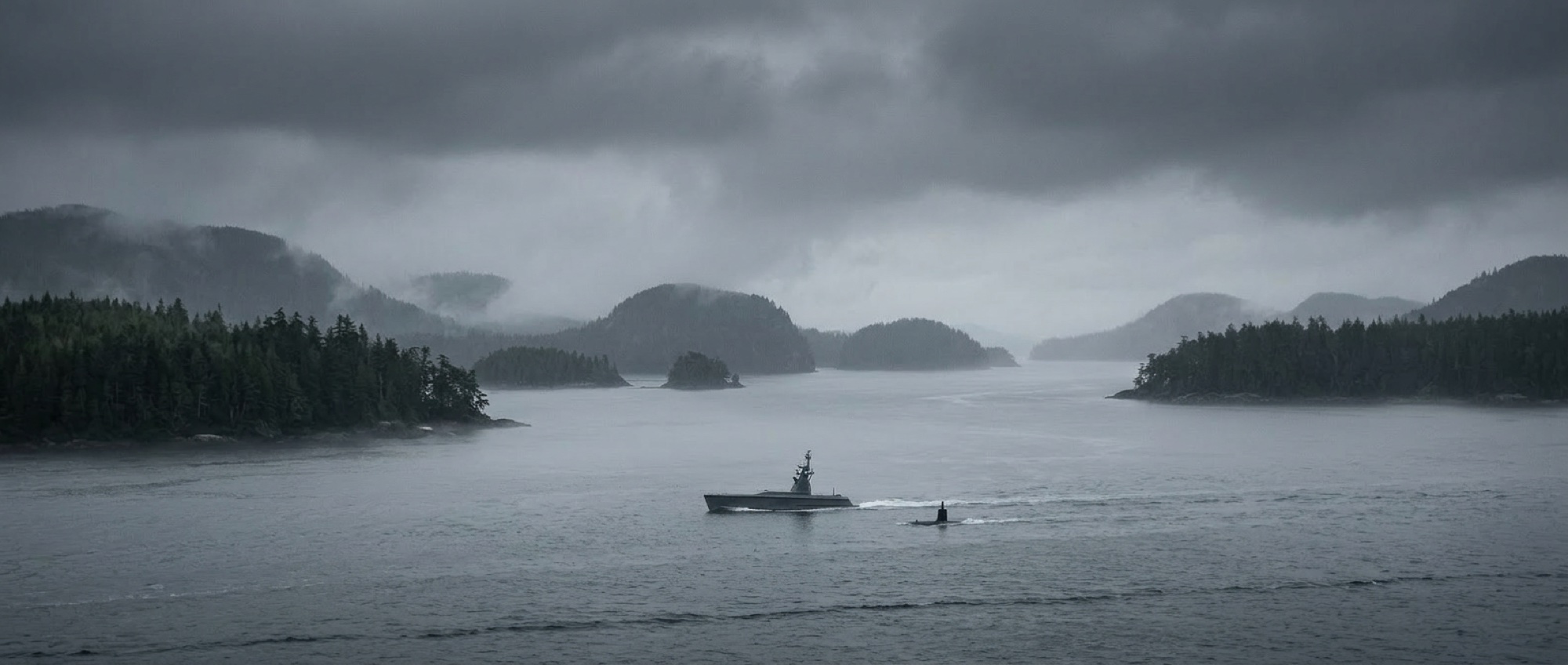
We took our name from the water we work on. The Salish Sea is a littoral in miniature: shallow, current-torn, fog-bound, and dense with traffic. It is an unforgiving place to test autonomous systems, which is precisely why we test here.
Since our first contract award in 2023, we've grown into a nine-program portfolio spanning four domains — every vehicle on a common autonomy stack, every sensor feeding one fused picture, every program named for the waters of the Pacific Northwest.
How we build
Endurance over spectacle
Our flagship's headline number is sixty days on station, not sixty knots. The littoral fight rewards whoever can stay — so we engineer for patience: solar-assisted drivetrains, hibernation duty cycles, burst comms.
Passive first
Hear before being heard, see before being seen. Our sensing philosophy starts with acoustic arrays and EO/IR that radiate nothing, holding active emissions in reserve as a choice, not a dependency.
Certify, don't demo
Autonomy decision cores deterministic enough to model-check. Regression suites that run on every build. The standard isn't 'it worked in the video' — it's 'it's certified for the water.'
Built where we sail
Our test range is our backyard. Cold water, ferry traffic, real weather, and a workforce that rides the Sound to work every morning and takes its judgment personally.
Named for the neighborhood
Every product is named for the water itself — Slackwater, Riptide, Backeddy, Tidefall, Spindrift — chosen deliberately so no historical military designation gets reused. If you've sailed the Sound, you know exactly what each one does.
A small crew with deep wakes
Lean by design: program managers who walk the shop floor, engineers who ride along on sea trials, and no layer between a decision and the water.
Programs
Integrated planning across all nine programs — from contract award to sea trial.
Business Development
The bridge between fleet operators and the engineering floor.
Subsea Engineering
Pressure-hull and deep-loiter vehicle design, from buckling analysis to wet test.
Autonomy Software
The Helmsman stack — the certifiable decision core on every SLS hull.
Naval Architecture
Hull forms across the envelope: displacement marathoners to 40-knot planing sprinters.
Acoustics
Passive acoustic detection and classification — the science behind Resonance.
Integration
Where payloads meet masts and software meets hulls; keepers of the fit-check.
IT & Security
Infrastructure — and the boundary around it — as disciplined as the fleet.

Build boats that think. Catch the 7:20 ferry home.
We hire naval architects, autonomy engineers, acousticians, and program managers who want their work in the water, not in a deck.
[email protected]